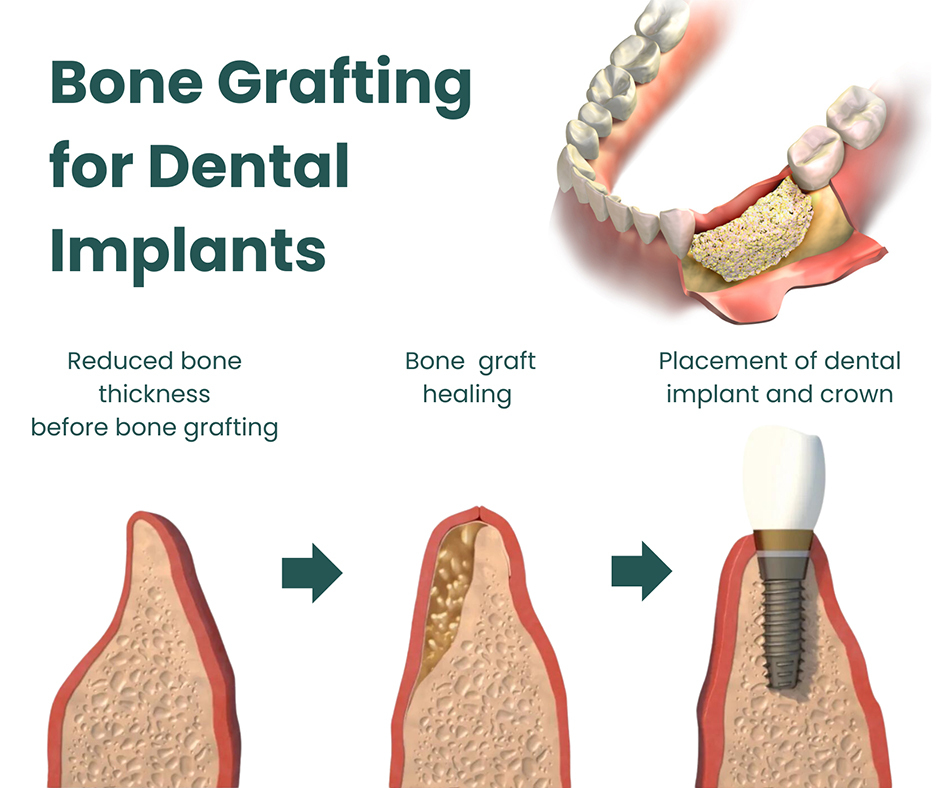
If you're considering a dental implant, you may have heard that you need a bone graft first. For many people, that's the moment the process starts to sound more complicated than they expected. In reality, bone grafting is one of the most common procedures in implant dentistry, and understanding why it's done makes the whole treatment plan easier to follow.
Why Bone Matters for Implants
A dental implant is a small post placed into the jawbone to act as a replacement root. For it to work, the bone has to grow tightly against the implant surface, a process called osseointegration. That requires enough bone height and width to surround the implant completely, with enough density to hold it firmly under chewing forces.
If the bone is too thin, too short, or too soft, the implant may not be stable, may be positioned poorly, or may leave part of its surface exposed. A graft rebuilds the foundation first.
Why Bone Goes Missing
The jawbone around a tooth exists to support that tooth. When the tooth is lost, the body begins to resorb, or break down, the bone that's no longer being used. The most rapid loss happens in the first several months after an extraction, and it continues gradually for years.
Other causes include:
- Periodontal disease, which destroys the bone that supports teeth
- Infection around a tooth or a failed root canal
- Trauma to the face or jaw
- Long-term denture wear, since dentures put pressure on the ridge without stimulating the bone beneath
- Natural anatomy, such as an enlarged sinus in the upper back jaw
Common Types of Bone Grafts
Socket preservation. Placed at the time a tooth is extracted. Graft material is packed into the empty socket to limit bone loss while it heals. If an implant is planned for later, this is one of the simplest ways to protect the site.
Ridge augmentation. Used when the jaw ridge has become too narrow or too short. Graft material is added to the side or top of the ridge, often covered with a protective membrane, to rebuild its shape.
Sinus lift. The upper back teeth sit just below the maxillary sinuses. After tooth loss, the sinus can expand downward, leaving little bone. A sinus lift gently raises the sinus membrane and places graft material beneath it to create room for an implant.
Block grafts. For larger defects, a solid piece of bone may be secured to the jaw with small screws. This is less common and is usually reserved for significant bone loss.
Where Graft Material Comes From
Graft materials fall into a few categories:
- Autograft: Bone taken from your own body, often from another area of the jaw
- Allograft: Processed human donor bone from a tissue bank
- Xenograft: Processed bovine (cow) bone mineral
- Synthetic materials: Biocompatible substances that mimic bone mineral
Most graft materials act as a scaffold. Your body gradually replaces them with your own new bone over the following months. The choice depends on the size and location of the defect and on your surgeon's assessment.
What the Procedure Is Like
Most grafts are performed with local anesthesia, often combined with sedation for comfort. The gum is opened, the graft is placed, and the area is closed with stitches. Many grafts take about an hour or less.
Afterward, swelling and mild discomfort for several days are normal. Some people notice a few small granules of graft material in their mouth during the first week, which is common and usually not a concern.
Healing and Timing
Healing time varies with the type and size of the graft:
- Socket preservation often heals enough for an implant in about three to four months
- Ridge augmentation and sinus lifts typically need four to nine months
- In some cases, a graft can be placed at the same time as the implant, shortening the overall timeline
Your surgeon uses X-rays or 3D scans to confirm the new bone is ready before the implant is placed.
Tips for Healing Well
Follow your surgeon's specific instructions first. In general:
- Eat soft foods and avoid chewing directly on the graft site
- Don't smoke, which significantly increases the risk of graft failure
- Avoid using straws and spitting forcefully for the first few days
- After a sinus lift, avoid blowing your nose and sneeze with your mouth open
- Take medications exactly as prescribed
- Attend every follow-up appointment
Why the Surgeon's Training Matters
Grafting and implant placement involve working around nerves, blood vessels, and the sinuses. An oral surgeon is trained specifically in surgery of the mouth, jaws, and face, including complex grafting and sedation. Often the oral surgeon handles the extraction, graft, and implant, and your general dentist places the final crown, bridge, or denture once everything has healed.
The Takeaway
Bone grafting is a way of preparing the foundation so an implant has the best chance of lasting. The longer a gap goes untreated, the more bone tends to be lost, and the more involved grafting may become. If you've recently lost a tooth or are about to have one removed, asking about socket preservation and your long-term replacement options early can keep your choices simpler.

Comments