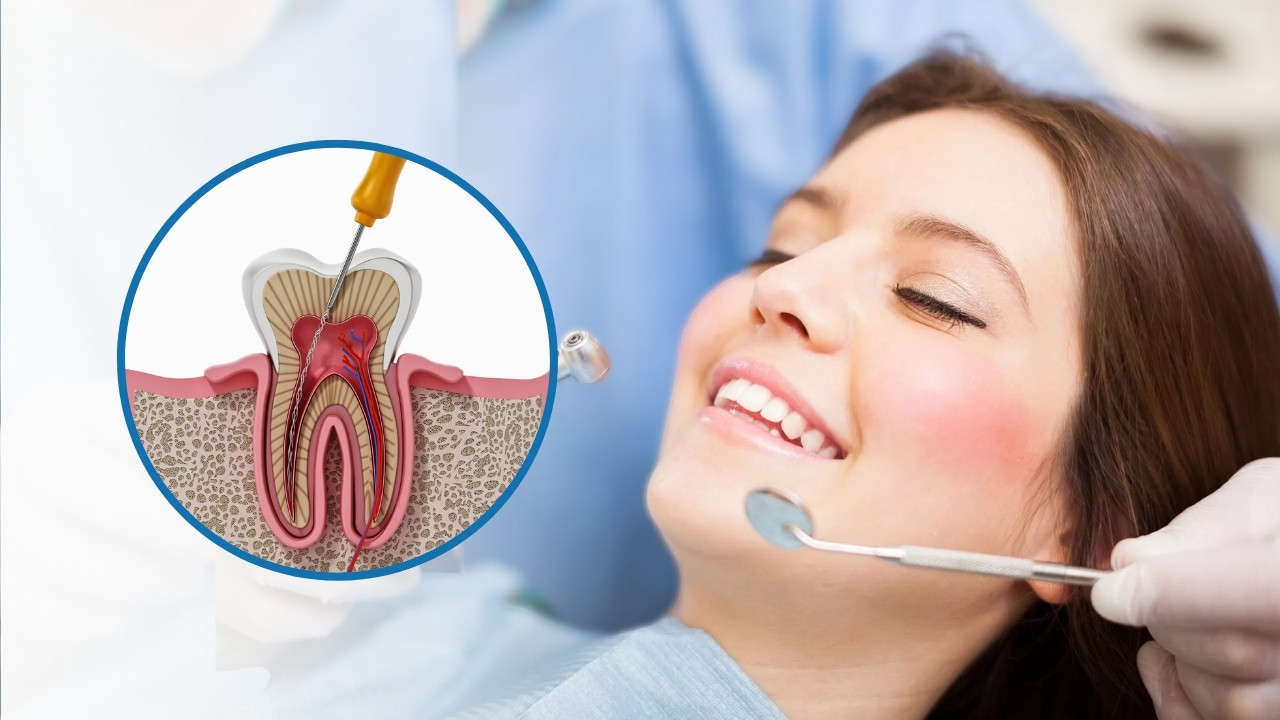
Root canals have a reputation built almost entirely on how they were performed decades ago. The modern procedure is routine, generally comfortable, and it saves teeth that would otherwise be extracted. Knowing what is happening removes most of the dread.
What the treatment is for
Inside every tooth is a chamber containing nerve and blood vessels, extending down through canals in each root. When bacteria reach that tissue, through deep decay, a crack, a failing restoration, or trauma, the tissue becomes inflamed and eventually dies.
Once that happens the infection spreads out through the tip of the root into the surrounding bone, forming an abscess. The tooth cannot heal on its own, and antibiotics do not reach the inside of the tooth in meaningful concentration, which is why they control symptoms temporarily and the problem returns.
Root canal treatment removes the affected tissue, cleans and shapes the canals, and seals them so bacteria cannot recolonize.
What the symptoms are
Lingering pain to hot or cold, particularly discomfort that continues for more than thirty seconds after the stimulus is removed.
Pain that wakes you, throbs, and worsens when you lie down, because blood pressure in the head increases.
Tenderness to biting or pressure. Swelling of the gum near the tooth, sometimes with a small bump that discharges and then reappears. Darkening of a single tooth.
Sometimes there are no symptoms at all and the problem is found on a routine x-ray as a dark area at the root tip. That is common with teeth that died some time ago.
What the appointment is like
Local anesthetic first, and this is the part most people are anxious about. A tooth that is already inflamed can be harder to numb fully, so tell the dentist if you feel anything. There are supplementary techniques available and no reason to endure discomfort.
A rubber dam is placed, isolating the tooth. This keeps the field clean and stops anything from reaching the back of your throat. It also makes the procedure considerably more predictable.
The chamber is opened, the canals are cleaned with fine instruments and irrigating solutions, shaped, and then filled with a sealing material. The access opening is closed with a temporary or permanent filling.
Front teeth with a single canal are quicker. Molars, with three or four canals and often complex anatomy, take longer and are sometimes split across two appointments.
For most patients the experience is comparable to having a large filling, other than the duration.
Afterward
Tenderness to biting for a few days is normal, particularly if there was an abscess, and responds to over-the-counter anti-inflammatory medication.
Severe pain, swelling, or fever afterward is not routine and warrants a call.
The tooth is no longer sensitive to temperature, because the nerve is gone. It also becomes more brittle, having lost internal structure and hydration, which leads directly to the next point.
The crown afterward is not optional
Back teeth that have had root canal treatment need full coverage. A crown holds the remaining structure together and distributes chewing force across the whole tooth rather than concentrating it on weakened walls.
Root-canalled molars left without crowns are among the most common vertical root fractures, and a vertical root fracture generally ends the tooth. All the money spent on the root canal is lost.
If you have had a root canal in the past and never had the crown placed, that is worth raising at your next appointment rather than waiting for a symptom.
Front teeth sometimes manage without full coverage if the access opening is small and the tooth is otherwise intact. Ask which category yours is in.
Success, retreatment, and specialists
Root canal treatment succeeds in the large majority of cases and treated teeth commonly last for decades.
When one fails, usually because a canal was missed, the seal broke down, or new decay reached the filling, retreatment is often possible: the existing filling is removed, the canals are recleaned, and the tooth is resealed. Alternatively an apicoectomy removes the tip of the root surgically.
Endodontists are specialists who complete additional years of training focused on this work and who have operating microscopes and specialized equipment. Referral makes sense for complex anatomy, retreatment, teeth with calcified canals, and cases where a general dentist encounters difficulty.
Plenty of straightforward root canals are handled well in general practice. A dentist who refers out the complicated ones is showing judgment.
The alternative, honestly
The alternative to a root canal is extraction. That is cheaper on the day and more expensive over time, because replacing the tooth with an implant or a bridge costs considerably more than the root canal and crown would have.
Keeping your own tooth is nearly always the better outcome when the prognosis is reasonable. Where it is not, a dentist saying so plainly is doing you a service.
Discussing it with a dentist who explains why the tooth is or is not worth saving, in terms of the specific remaining structure, gives you the information to decide rather than a decision to accept.

Comments