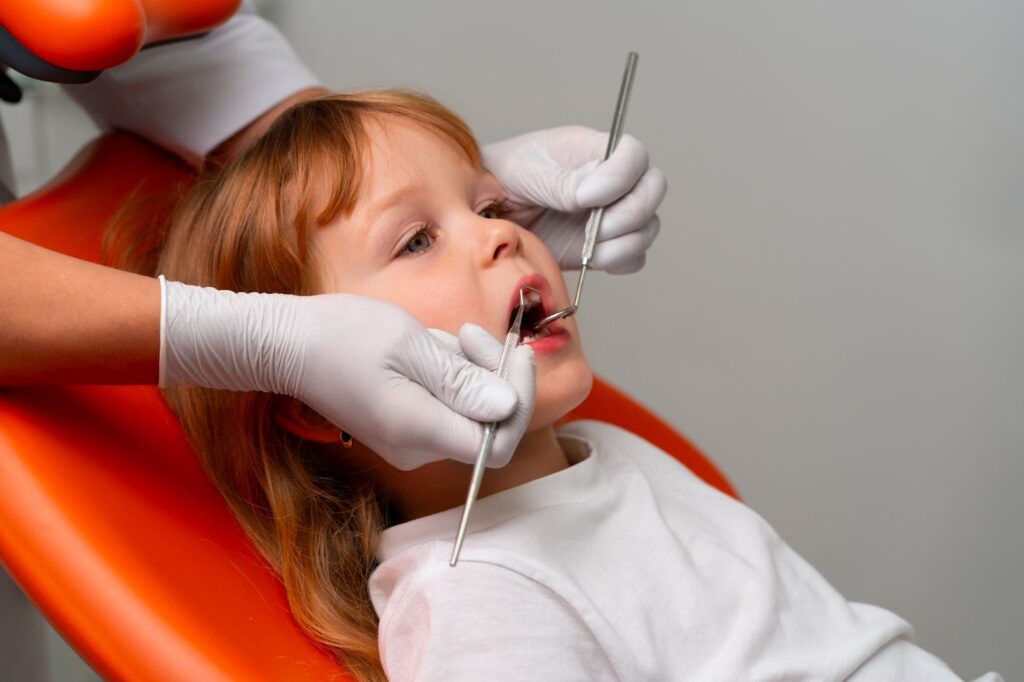
Most parents assume orthodontic treatment is something to think about when their child becomes a teenager. So when a dentist suggests an orthodontic evaluation for a seven-year-old, the reaction is often surprise. Seven seems young. Many of those baby teeth have not even fallen out yet. But there is a very specific reason why orthodontists and pediatric dental organizations recommend an initial screening at this age, and it has everything to do with timing.
Why Should a Child See an Orthodontist at Age Seven?
By age seven, most children have a mix of baby teeth and permanent teeth. The first permanent molars have typically erupted, and the permanent incisors are either in place or well on their way. This combination gives an orthodontist enough information to evaluate how the jaws are growing, how the teeth are coming in, and whether any developing problems need to be addressed early.
The recommendation comes from the American Association of Orthodontists, and it is not about starting treatment early for every child. Most children who are screened at age seven will not need any immediate intervention. The orthodontist may simply say, "Everything looks fine, let us check again in a year." But for the small percentage of children who do have a developing issue, catching it at this age can make a meaningful difference in the complexity and duration of future treatment.
What Signs Suggest a Child Might Need Braces
There are several indicators that an orthodontist evaluates during an early screening. Some are visible to parents, while others require professional assessment. Visible signs that a child might need orthodontic attention include crowding of the front teeth, noticeable spacing between teeth, an upper jaw that appears too narrow, and front teeth that do not meet when the child bites down. Habits like prolonged thumb sucking or mouth breathing can also contribute to orthodontic problems and are worth discussing at an early evaluation.
Less obvious signs include a crossbite, where the upper teeth bite inside the lower teeth on one or both sides. Crossbites can cause the lower jaw to shift to one side when biting, which over time can lead to asymmetric growth. Early correction of a crossbite is one of the most common reasons for intervention in young children. I recall a patient who came in at age seven with a posterior crossbite. Her lower jaw was shifting to the left every time she closed her mouth. We corrected the crossbite with a simple palatal expander over about six months, and her jaw growth normalized. Had we waited until she was a teenager, the asymmetry might have become a permanent skeletal issue.
Evaluating Jaw Growth
One of the most important things an orthodontist assesses at age seven is the relationship between the upper and lower jaws. The jaws are still growing at this age, and certain discrepancies are much easier to influence while growth is active. A child whose lower jaw is significantly behind the upper jaw, a condition called a Class II skeletal pattern, may benefit from a growth modification appliance that encourages the lower jaw to grow forward. Waiting until growth is complete eliminates this option, and the only alternative at that point may be jaw surgery.
Similarly, a child whose lower jaw is growing faster than the upper jaw, creating an underbite, can sometimes be treated with a face mask or reverse-pull headgear that stimulates forward growth of the upper jaw. These types of interventions are time-sensitive. They work best when there is active growth to harness, and age seven to ten is often the ideal window.
Space Analysis
Another key part of the age-seven evaluation is a space analysis. The orthodontist looks at how much room is available in the jaws for the permanent teeth that have not yet erupted. Using X-rays, we can see the developing permanent teeth beneath the gums and estimate their size relative to the available space. If it is clear that there will not be enough room, we can begin planning strategies to manage the transition from baby teeth to permanent teeth. In some cases, this means placing a space maintainer to preserve room when a baby tooth is lost early. In other cases, it means monitoring closely and timing the loss of specific baby teeth to guide the permanent teeth into better positions.
Screening Does Not Always Mean Treatment
I want to emphasize this point because it is a common source of anxiety for parents. An orthodontic screening at age seven is just that: a screening. It is a brief evaluation to determine whether anything needs attention now or whether the child can simply be monitored over time. In my practice, roughly seven out of ten children I see at age seven do not need any treatment at that time. I place them on a recall schedule and see them every six to twelve months to monitor their growth and dental development.
For the children who do need early treatment, the intervention is typically focused on one specific problem, such as a crossbite, a severely protruding front tooth that is at risk of trauma, or a habit like thumb sucking that is altering jaw growth. Early treatment is targeted and usually short, lasting six to eighteen months. It is not full comprehensive treatment, which typically happens later when all or most permanent teeth have erupted.
The Value of Information
Even when no treatment is needed at age seven, the information gained from an early evaluation is valuable. It gives the orthodontist a baseline. When that child returns at age ten or twelve, the orthodontist can compare the current situation to what was observed at seven and make much more informed decisions about timing and treatment approach. It also gives parents time to plan. Knowing that your child will likely need braces in a few years allows you to explore insurance options, budget for treatment, and choose a provider without feeling rushed.
If your child is approaching age seven and has not had an orthodontic evaluation, consider scheduling one. It is a low-pressure appointment with potentially significant long-term benefits. The goal is not to put braces on young children. The goal is to make sure that when the time does come for treatment, everything is positioned for the best possible outcome.

Comments