Most people know that braces straighten teeth, but very few understand the remarkable biology happening beneath the surface. When a patient sits in my chair for the first time and asks, "So how do braces actually move teeth?" I love walking them through it. The answer involves a fascinating partnership between carefully engineered hardware and the body's own healing response.
I have been placing braces for over a decade, and I still find the underlying science genuinely impressive. Let me take you through the process from start to finish so you can appreciate what is really going on in your mouth during treatment.
The Basic Components
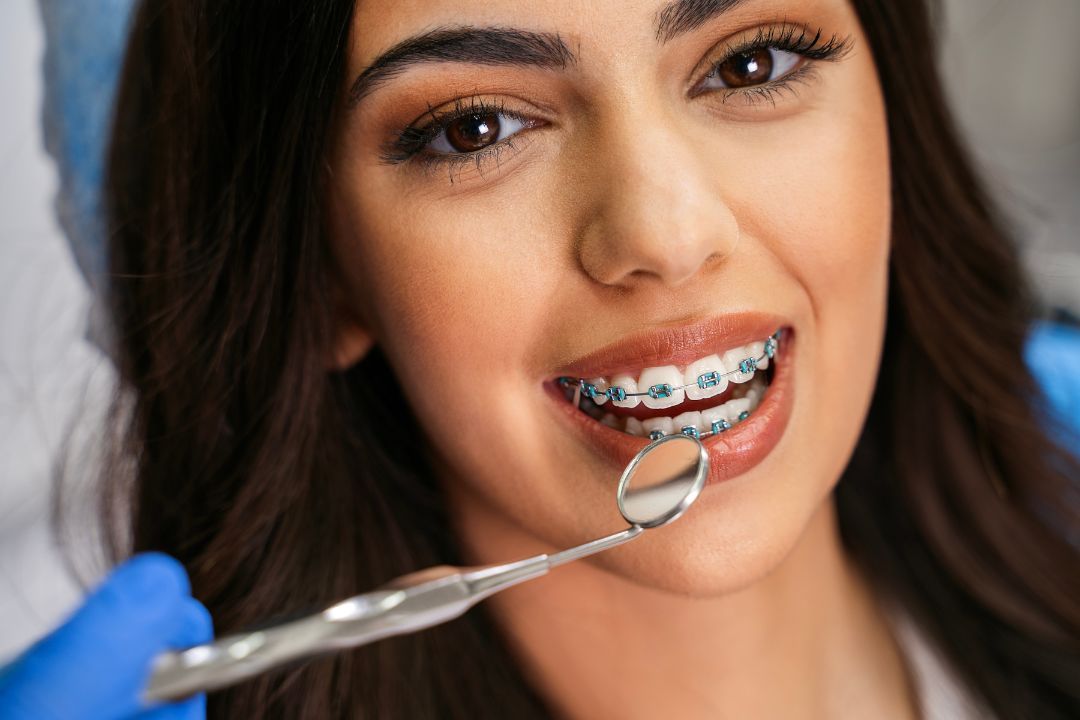
Metal braces consist of three primary parts: brackets, archwires, and ligatures. Brackets are the small squares bonded directly to each tooth with a dental adhesive. The archwire is a thin metal wire that threads through every bracket, creating a track that guides tooth movement. Ligatures, which are tiny elastic bands or fine wires, hold the archwire in place inside each bracket's slot.
Each of these components plays a specific role. The bracket acts as a handle on the tooth, giving the orthodontist a point of control. The archwire provides the force. And the ligatures keep everything connected so the system works as a unit.
How Braces Move Teeth Through Bone
Here is the part that surprises most patients: your teeth are not cemented rigidly into your jawbone. Each tooth sits in a socket and is connected to the surrounding bone by a thin layer of tissue called the periodontal ligament. This ligament is alive, responsive, and absolutely essential to orthodontic treatment.
Braces move teeth by applying gentle, continuous forces to the crowns. When the archwire pushes or pulls on a bracket, that force transfers through the tooth and into the periodontal ligament. On the side where the tooth is being pushed, the ligament gets compressed. On the opposite side, it gets stretched. The body responds to this mechanical stress with a biological process called bone remodeling.
On the compressed side, specialized cells called osteoclasts break down bone to make room for the tooth to move. On the stretched side, cells called osteoblasts build new bone to fill in the space the tooth left behind. This cycle of breakdown and rebuilding is what allows teeth to physically travel through bone. It is slow, which is why treatment typically takes one to two years, but it is remarkably reliable.
The Role of the Archwire
The archwire is where most of the action happens. In the early stages of treatment, I typically use a thin, flexible wire made from nickel-titanium alloy. These wires have shape memory, meaning they want to return to their original curved shape no matter how much they are bent. When I thread this wire through brackets on crooked teeth, the wire constantly tries to straighten itself, pulling each tooth gently toward its proper position.
As teeth become more aligned, I switch to progressively stiffer wires, often stainless steel. These thicker wires can deliver more precise forces for fine-tuning tooth positions, closing gaps, and correcting the bite. The sequence of wires, from flexible to rigid, is a core part of treatment planning.
What Forces Do Braces Use to Straighten Teeth
Braces use several types of mechanical forces to straighten teeth, and understanding them helps explain why treatment involves so many adjustments. The primary forces include tipping, which tilts the crown of a tooth in one direction; translation, which moves the entire tooth, root and all, in a parallel fashion; rotation, which spins a tooth around its long axis; and intrusion or extrusion, which push a tooth deeper into or pull it further out of the bone.
Each of these movements requires a different combination of wire shape, bracket position, and sometimes additional hardware like springs or elastic chains. In my experience, getting all of these forces to work in harmony is both the challenge and the art of orthodontics. A well-planned sequence of adjustments gradually brings every tooth into alignment.
Adjustment Appointments and Why They Matter
Every four to eight weeks, patients come in for an adjustment. During these visits, I evaluate how the teeth have responded, replace or tighten the archwire, change the ligatures, and sometimes add new components. Each appointment is an opportunity to redirect forces and keep treatment progressing efficiently.
I had a teenage patient a few years ago who kept postponing his adjustment appointments. Over a three-month gap, his teeth had moved as far as the original wire would take them, and then progress simply stalled. Once we got him back on schedule with a new wire, things picked up again quickly. The lesson is simple: consistent follow-up appointments are essential because the forces from each wire configuration eventually get used up.
The Importance of Light, Continuous Force
One of the most important principles in orthodontics is that lighter forces actually move teeth more efficiently than heavy ones. It sounds counterintuitive, but heavy force can damage the periodontal ligament and actually slow down tooth movement. When I explain this to patients who ask me to "crank it tighter" so treatment goes faster, I tell them that gentle, steady pressure is the sweet spot. The biology works best when it is not overwhelmed.
This is also why modern braces have become more comfortable than the ones many parents remember from their own childhoods. Advances in wire technology and bracket design mean we can achieve excellent results with less force and less discomfort than ever before.
What Happens After the Braces Come Off
Once the teeth are in their final positions, the braces are removed and the patient receives a retainer. The bone around each tooth needs time to fully solidify in its new location. Without a retainer, teeth have a strong tendency to drift back toward their original positions, especially in the first year after treatment.
I always tell my patients that braces do the moving, but the retainer protects the investment. Wearing it as directed is just as important as every adjustment appointment that came before it.
Understanding how metal braces work can make the entire treatment experience less mysterious and more manageable. The process is grounded in real biology, guided by precise engineering, and refined at every appointment. It is a system that has been perfected over decades, and it remains one of the most reliable ways to achieve a healthy, well-aligned smile.

Comments