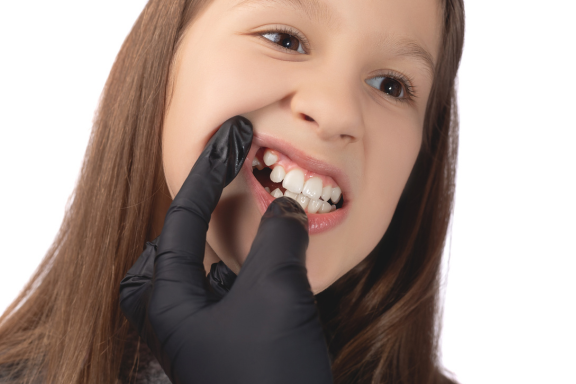
The canine teeth are some of the most important teeth in your mouth. They are the cornerstone teeth of the dental arch, designed for tearing food and guiding the jaw during side-to-side movements. They also play a significant role in the aesthetics of your smile. So when a canine tooth gets stuck in the bone and fails to erupt into its proper position, it creates both a functional and cosmetic problem that needs to be addressed.
Impacted canines are the second most commonly impacted teeth after wisdom teeth, and they are a challenge I encounter regularly in my practice. The good news is that in most cases, we can guide these stuck teeth into their rightful position without removing them.
What Is an Impacted Canine Tooth
An impacted canine tooth is a permanent canine that has failed to erupt through the gum into the mouth at the expected time. While most permanent teeth come in between the ages of six and thirteen, the upper canines (also called cuspids) are typically among the last to arrive, usually erupting around ages eleven to thirteen. When one of these teeth gets stuck, either in the bone of the palate (the roof of the mouth) or in the bone above the other teeth on the cheek side, it is considered impacted.
The upper canines are impacted far more often than the lower canines. Studies suggest that about 2 percent of the population has at least one impacted upper canine, and it occurs more frequently in females than males. In about a third of cases, both upper canines are impacted.
Sometimes the canine is only partially impacted, meaning it has started to move toward the surface but has stalled in an abnormal position. Other times, it is deeply embedded in the bone, oriented in an unusual direction, and nowhere close to the path it should be following.
Why Canines Get Stuck
Several factors can cause a canine to become impacted. One of the most common is insufficient space in the dental arch. If the jaw is crowded and there is not enough room for the canine to descend, it may become blocked by adjacent teeth.
The path of eruption matters too. The upper canine has the longest and most complex eruption path of any tooth, traveling from high up near the eye socket, along the side of the nose, and then curving outward and downward into position. With such a long journey, there are many opportunities for the tooth to veer off course.
Missing or undersized lateral incisors (the teeth right next to the front teeth) are a significant risk factor. The roots of the lateral incisors appear to serve as a guide for the erupting canine. When these teeth are absent or smaller than normal, the canine loses its guidance and may wander off in the wrong direction.
Genetics play a role as well. Impacted canines tend to run in families, and they are more common in people with other dental anomalies such as extra teeth (supernumeraries) or congenitally missing teeth.
How Impacted Canines Are Diagnosed
Impacted canines are usually discovered during routine dental exams. A dentist might notice that the baby canine is still present well past the age when it should have fallen out, or they might notice that the permanent canine simply has not appeared. A panoramic X-ray reveals the position of the unerupted tooth, and in many cases a cone-beam CT scan (3D X-ray) is taken to determine the exact location, angulation, and relationship of the impacted canine to the roots of neighboring teeth.
This imaging is critical for treatment planning. Knowing exactly where the tooth is and what direction it is facing allows us to plan the most efficient path to bring it into alignment.
How Do You Fix an Impacted Canine Without Extraction
The standard approach to fixing an impacted canine without extraction involves a partnership between an oral surgeon and an orthodontist. The process has two main phases.
First, the oral surgeon performs a minor surgical procedure to expose the impacted tooth. This involves lifting the gum tissue and, if necessary, removing a small amount of bone covering the tooth. A small orthodontic bracket with a gold chain or elastic thread is then bonded directly to the exposed tooth. The gum tissue is repositioned, and the chain or thread is left accessible.
In the second phase, the orthodontist uses the chain to apply a gentle, sustained force that gradually guides the impacted canine through the bone and gum tissue into its proper position in the arch. This is done in conjunction with braces on the other teeth, which create space for the canine and provide anchorage for the pulling forces.
I always explain to patients and parents that this process requires patience. Moving an impacted canine into position is not fast. Depending on how deeply impacted the tooth is and how far it needs to travel, this part of treatment can take anywhere from 6 to 18 months, sometimes longer. I had a case a couple of years ago where a deeply impacted canine took 14 months of gentle traction before it was finally visible in the mouth. But once it arrived, it lined up beautifully with the rest of the teeth.
The key is applying the right amount of force. Too much force can damage the tooth or the roots of adjacent teeth. Too little, and the tooth will not move. This is where experience and careful monitoring through periodic X-rays make a real difference in outcomes.
When Extraction Is Necessary
While the goal is almost always to save the impacted canine, there are situations where extraction becomes the better option. If the tooth is fused to the bone (ankylosis), it will not respond to orthodontic forces and cannot be moved. If the tooth is in a position where attempting to move it would damage the roots of neighboring teeth, extraction may be recommended. In rare cases where the impacted canine has developed a cyst around it, removal becomes necessary for health reasons.
When a canine must be extracted, the space can be managed in several ways. The premolar behind it can be moved forward to fill the gap, or the space can be maintained for a future dental implant. A skilled orthodontist and restorative dentist can often create a result that looks and functions well even without the natural canine.
The Importance of Early Detection
Early detection of a potentially impacted canine can significantly simplify treatment. By age seven or eight, a dental professional can assess whether the canine is developing normally by feeling for the bulge of the tooth through the gum above the baby canine. If the canine does not appear to be descending properly, early intervention such as extracting the baby canine can sometimes redirect the permanent canine onto a better path, potentially avoiding the need for surgical exposure altogether.
This is one of many reasons the first orthodontic evaluation by age seven is so important. Catching a canine that is heading in the wrong direction early gives us options that simply are not available once the tooth has become fully impacted in an unfavorable position. If your child's baby canine seems to be hanging on longer than expected, or if the permanent canine has not appeared by age thirteen, an evaluation is well worth your time.

Comments