Orthodontics has always been about applying forces to teeth to move them into better positions. But for a long time, one of the biggest challenges in the field was this: when you push on a tooth, something has to push back. Every force needs an anchor point, and traditionally, that anchor was other teeth. The problem is that anchor teeth tend to move too, sometimes in directions you do not want.
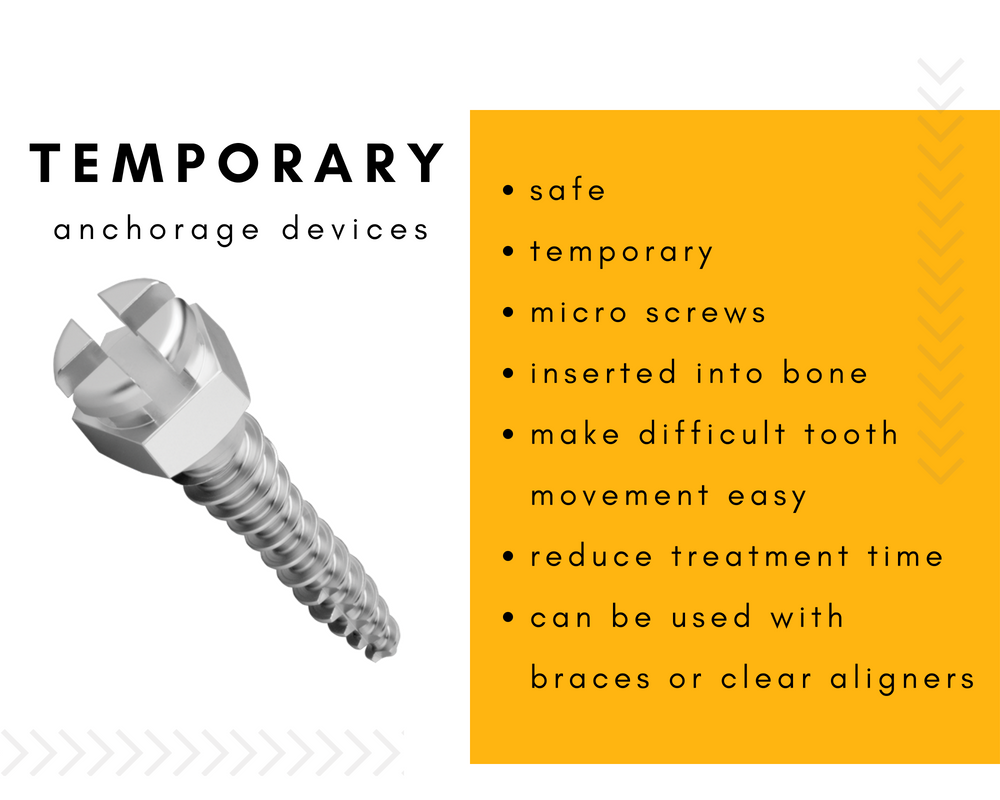
That is where temporary anchorage devices, commonly called TADs, changed the game. They gave orthodontists a fixed point of anchorage that does not move, opening up treatment possibilities that were previously difficult or impossible without surgery.
What Are TADs in Orthodontics
TADs are small titanium screws, typically between 6 and 12 millimeters long and about 1.5 millimeters in diameter. They are placed directly into the jawbone through the gum tissue and serve as fixed anchor points for orthodontic forces. Unlike dental implants, TADs are temporary. They are designed to stay in place only for the duration of the orthodontic movement they are supporting, and they are removed easily once their job is done.
Think of it this way: if you wanted to move a heavy piece of furniture across a room by pulling on a rope, you would need to brace yourself against something solid, like a wall. TADs serve as that wall for orthodontic forces. They provide a stable, immovable point that allows the orthodontist to move specific teeth precisely without unwanted side effects on other teeth.
How TADs Are Used in Treatment
The applications for TADs in orthodontics are remarkably varied. One of the most common uses is closing space after a tooth extraction. When a tooth is removed and the remaining teeth need to slide into the gap, TADs prevent the anchor teeth from drifting forward while the target teeth are being moved.
TADs are also used to intrude overerupted molars. When a tooth is lost and not replaced, the opposing tooth can drift downward (or upward) into the empty space over time. Pushing that overerupted tooth back into proper position is extremely difficult without a fixed anchor point, but a TAD makes it straightforward.
Other uses include correcting open bites by intruding back teeth, retracting protruding front teeth, uprighting tilted molars, and even assisting with asymmetric tooth movements. In my experience, TADs have been a genuine breakthrough for cases that previously would have required jaw surgery. I have had several adult patients avoid surgical correction entirely because TADs allowed me to achieve the necessary tooth movements through orthodontics alone.
The Placement Procedure
Placing a TAD is a minor procedure that typically takes about 10 to 15 minutes. After numbing the area with a local anesthetic, I use a small driver to screw the TAD directly through the gum tissue and into the bone. No incision is needed, and no stitches are required afterward.
Most patients are surprised by how quick and uneventful the process is. The local anesthetic ensures they feel no pain during placement. Afterward, mild soreness at the site is common for a day or two, similar to what you might feel after a routine dental cleaning in a sensitive area. Over-the-counter pain relievers are usually sufficient.
Do TADs Hurt When Placed
This is the question I get asked most frequently, and I understand the concern. The idea of a screw being placed into your jawbone sounds intimidating. But in reality, TAD placement is one of the least uncomfortable procedures we perform in the office.
The local anesthetic completely numbs the area, so patients feel pressure but not pain during insertion. The screw is so small that the amount of tissue disruption is minimal. I often compare it to getting a piercing, though the sensation is even less noticeable because of the numbing.
After the anesthetic wears off, most patients report mild tenderness that resolves within 24 to 48 hours. I have had patients tell me they expected it to be much worse and were pleasantly surprised. One teenager told me, "That was it? I was nervous for nothing." That reaction is very common.
Living with TADs
Once placed, TADs are small and low-profile. Most patients quickly forget they are there. The top of the screw sits just above the gum line, and the orthodontist attaches a small elastic, spring, or wire from the TAD to the teeth being moved.
Keeping the area around the TAD clean is important. I recommend gentle brushing around the screw head with a soft toothbrush and rinsing with an antimicrobial mouthwash. Good hygiene helps prevent inflammation of the gum tissue around the TAD, which is the most common minor complication.
In rare cases, a TAD may become loose and need to be replaced. This is not a painful experience. The loose screw is simply removed, and a new one can be placed in a slightly different location if needed. The success rate for TADs is high, with most studies reporting stability rates of 85 to 95 percent.
Removal
Removing a TAD is even simpler than placing one. In many cases, the area does not even need to be numbed. I use the same small driver to unscrew the TAD, and the entire process takes less than a minute. The tiny hole in the gum tissue heals on its own within a few days, and the bone fills in completely over the following weeks.
Patients are often amazed at how anticlimactic TAD removal is. There is no lasting mark, no scar, and no residual discomfort.
Why TADs Matter for Modern Orthodontics
Before TADs, certain tooth movements required headgear, complex multi-bracket mechanics, or orthognathic surgery. Each of those options carries either significant patient compliance demands or surgical risk. TADs provide a simpler, more predictable alternative for many of those same movements.
In my own practice, TADs have allowed me to offer patients treatment outcomes that would not have been achievable a generation ago without surgery. They represent one of the most significant advances in orthodontic mechanics in the last 30 years, and they continue to expand the boundaries of what we can accomplish without an operating room.
If your orthodontist recommends a TAD as part of your treatment plan, I encourage you to see it as a positive sign. It means your orthodontist is using every available tool to give you the best possible result with the least invasive approach.

Comments