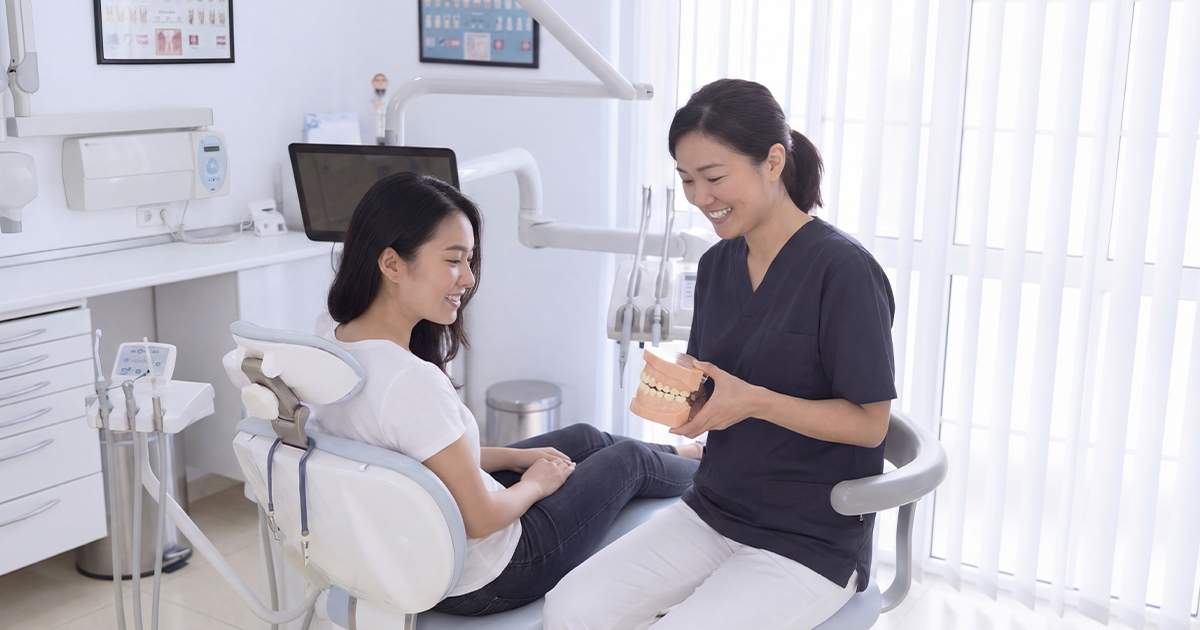
Most people think of orthodontics as a way to straighten crooked teeth, and that is certainly part of what we do. But a huge portion of my work focuses on something patients often overlook: the bite. How your upper and lower teeth come together when you close your mouth matters enormously for your long-term oral health, comfort, and function. Yet most people have never had their bite properly explained to them.
I had a patient last year who came in saying her teeth looked fine and she just wanted to close a small gap. When I examined her bite, I found a significant crossbite on the left side and an open bite in the front. She had no idea. Her teeth appeared reasonably straight from the outside, but her bite was causing asymmetric wear, jaw discomfort, and early bone loss on several teeth. This is far more common than you might think.
What Does a Normal Bite Look Like
Before talking about what can go wrong, it helps to understand what a healthy bite looks like. In an ideal bite, the upper teeth sit slightly outside the lower teeth all the way around the arch. The upper front teeth overlap the lower front teeth by about two to three millimeters vertically. When you bite down, all or most of your back teeth make contact simultaneously, distributing chewing forces evenly. The jaw joints sit comfortably in their sockets without strain, and you can move your jaw side to side and forward smoothly.
Very few people have a textbook perfect bite naturally. Minor variations are normal and do not require treatment. But when the bite deviates significantly from this ideal, it can create problems that worsen over time.
Overbites: More Than Just Protruding Teeth
An overbite refers to the vertical overlap of the upper front teeth over the lower front teeth. Some degree of overbite is normal and healthy. It becomes a concern when it is excessive, meaning the upper teeth cover too much of the lower teeth or the lower teeth bite into the palate behind the upper teeth.
A deep overbite can cause the lower front teeth to wear against the backs of the upper front teeth, gradually thinning them over decades. In severe cases, the lower teeth actually contact the gum tissue behind the upper teeth, creating chronic irritation or even tissue damage. Some patients with deep bites develop pain when chewing because the lower jaw is essentially locked in place, unable to move forward freely without the lower teeth hitting the upper teeth.
People sometimes confuse overbite with overjet, which is how far forward the upper teeth sit relative to the lower teeth. A large overjet, where the top teeth stick out prominently, increases the risk of trauma; those teeth are more likely to be injured during sports or falls. Both conditions are very treatable with orthodontics.
Underbites and Jaw Relationships
An underbite occurs when the lower front teeth sit in front of the upper front teeth when biting down. This can be caused by a lower jaw that has grown too far forward, an upper jaw that has not grown enough, lower teeth that are tilted outward, upper teeth that are tilted inward, or some combination of these factors.
Underbites affect chewing efficiency significantly because the teeth are not designed to function in that reversed relationship. Patients with underbites often unconsciously shift their jaw to find a more comfortable biting position, which can strain the jaw joints and muscles over time. The asymmetric forces can also cause uneven wear on teeth that are bearing loads they were not designed for.
In growing children, early intervention for an underbite can sometimes redirect jaw growth and avoid the need for surgery later. This is one of the reasons orthodontic organizations recommend children be evaluated by age seven, even though most treatment does not start that early.
Crossbites: The Bite Problem People Miss
A crossbite exists when some upper teeth sit inside the lower teeth rather than outside, as they should. This can affect the front teeth, the back teeth, or both. It can occur on one side or both sides.
Crossbites are particularly problematic because they often cause the lower jaw to shift to one side when closing. This shift places uneven stress on the jaw joints, potentially leading to joint problems, facial asymmetry, and accelerated wear on specific teeth. In children, an uncorrected crossbite can actually cause the jaw to grow asymmetrically over time, because the bones are adapting to the abnormal position.
I treated a teenager whose parents brought her in for crowding. During the exam, I noticed she had a crossbite on the right side that had been present since childhood. Her chin had already deviated slightly to that side because her jaw had adapted to the shifted position over years of growth. Correcting the crossbite early would have been much simpler. By the time she reached me, we needed a more involved treatment to address both the bite and the asymmetry.
What Problems Does a Bad Bite Cause
The consequences of an uncorrected bite problem can be subtle at first but significant over time. What problems does a bad bite cause? The list includes uneven or accelerated tooth wear, increased risk of cracking or fracturing teeth, jaw joint pain and dysfunction, chronic headaches and facial muscle tension, difficulty chewing food thoroughly, gum recession in areas of abnormal force, and bone loss around teeth that bear disproportionate loads.
Many of these effects develop gradually over decades, which is why people often do not connect their symptoms to their bite. A forty-year-old experiencing jaw pain may not realize it relates to a bite problem that has been present since adolescence. The body compensates for a long time until it cannot anymore.
Do You Need Treatment if Your Teeth Look Straight
This is a question I hear frequently: do I need to fix my bite if my teeth look straight? The answer depends on the severity of the bite discrepancy and whether it is causing or likely to cause problems. Mild bite variations that are not producing symptoms or wear patterns can often be monitored without treatment. Significant bite problems usually benefit from correction even if the teeth appear aligned from the front.
The tricky part is that you cannot fully evaluate your own bite at home. It requires a trained eye, proper imaging, and sometimes bite analysis tools to determine whether a bite relationship is problematic. What feels normal to you may actually be your jaw compensating for a mismatch that is slowly causing damage.
My recommendation is straightforward: if you have any symptoms like jaw clicking, facial pain, headaches, difficulty chewing, or if your dentist has mentioned uneven wear on your teeth, an orthodontic evaluation is worthwhile. Even if treatment is not recommended, at least you will understand what is happening with your bite and can make informed decisions about your care. Your bite is one of those things that is easy to take for granted until problems develop, and by then, the fix is often more involved than it would have been with earlier intervention.

Comments